PS in a Letter: The Meaning in One Minute
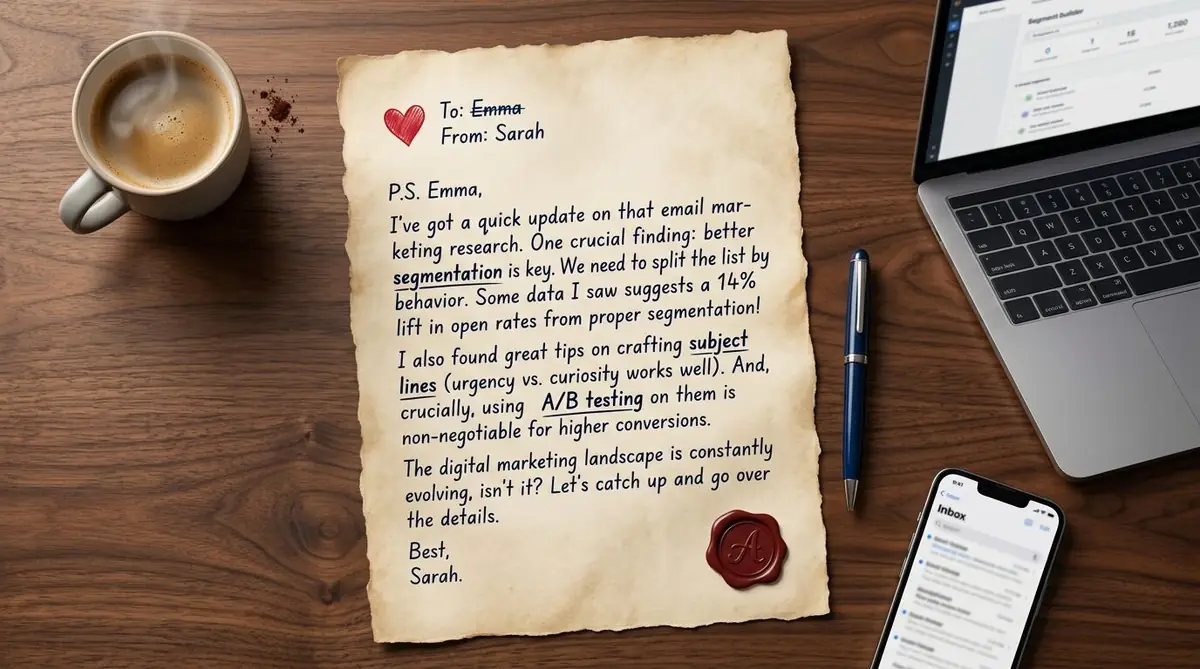
If you see PS, P.S., or P. S. at the end of a letter, they all point to the same idea: a postscript. The writer has finished the main message, signed it, and then added one more thought afterward.
For example:
Best,
Sarah
PS: Don't forget to bring the book I lent you.
The PS does not need a second greeting or a new signature. It sits below the signature and starts with PS:. A second postscript can be labelled PPS:, though it should be used sparingly.
Quick rule: If removing the PS would make the letter incomplete, the information belongs in the main body, not the PS.
Where Does “PS” Come From?
PS is short for the Latin phrase post scriptum, which translates literally to “written after.” Before typewriters and word processors, a postscript let a writer add a note without recopying an entire handwritten page. The habit stuck because it still solves a real problem: how to add one more thought without rebuilding the message.
That history is also why a PS carries a slightly informal, personal tone even in professional writing. It reads as something the writer thought of on their own, rather than a planned part of the message — which is exactly what makes it useful.
How to Use PS in a Letter Correctly
Adding a PS is simple, but placement and purpose matter. Follow this process so the note feels intentional rather than tacked on.
Finish the main letter first
Write the complete message, including the conclusion and signature, before you think about a PS. This keeps the main argument, request, or story logically complete on its own.
Ask whether it belongs in the main body
If the detail is essential to the reader's decision, deadline, instructions, price, or next step, put it in the main body. A PS should be supplemental, never a hiding place for important information.
Add PS below the signature
Start a new line with PS: and write one concise thought. P.S.: works too — modern usage is flexible about punctuation, so consistency matters more than the style you pick.
Make the note useful
A strong postscript gives the reader something to act on, remember, or appreciate — a reminder, a personal detail, a small benefit, or a final invitation.
Keep it short
There's no formal word limit, but one or two sentences is the sweet spot. If the note needs several paragraphs, it's probably part of the main message.
Proofread the final line
A postscript is highly visible because it comes last. Check names, dates, links, spelling, and the action you're asking for before you send.
PS in a Letter: Examples
Seeing the format in context makes the rule easy to remember. Here are practical examples for common situations.
Friendly letter
Take care,
Maya
PS: The café we talked about opens at 8 a.m. on Saturday.
The main message ends normally; the PS adds a useful reminder.
Thank-you letter
Warmly,
Daniel
PS: I finally tried the recipe you recommended. It was excellent.
The postscript adds warmth and a personal detail rather than a new topic.
Business letter
Kind regards,
Aisha Khan
PS: I have attached the revised schedule for your review.
Keep the note factual. If the attachment is essential to a decision, mention it in the body too.
Invitation
Best,
Leo
PS: Parking is available behind the venue after 6 p.m.
The invitation is already complete; the parking note is a helpful extra.
Where Should PS Go in a Letter?
The traditional placement is after the signature. A simple structure looks like this:
- Greeting
- Main body
- Closing
- Signature
- PS and the additional note
In a handwritten letter, add the PS at the bottom after signing. In a typed letter, leave a clear visual break between the signature and the postscript so the reader recognises it immediately.
PS vs. P.S. vs. PPS: Is There a Difference?
PS and P.S. mean the same thing. The periods are a punctuation convention, not a change in definition. You may also see P. S., especially in older writing.
PPS means a second postscript, used when the writer has already added a PS and then remembers another afterthought:
PS: Bring the photos.
PPS: And bring the old album too.
You generally don't need a PPS in modern professional writing. If you keep remembering major points, reorganise the main message instead.
When Should You Use a PS?
Use a postscript when the extra detail is genuinely secondary and benefits from the final position. Good use cases include:
- A friendly reminder that isn't central to the letter.
- A personal detail that adds warmth.
- A memorable final thought.
- A simple logistical tip, such as parking or timing.
- A secondary invitation or optional next step.
- A concise call to action in an email or newsletter.
Use it less often in formal legal, academic, or highly structured documents. In those contexts, important information usually belongs in the correct section rather than after the signature.
When Should You Avoid a PS?
A PS becomes counterproductive when it creates confusion or looks like it's manipulating attention. Avoid it when:
- The note contains information the reader must know to understand the main message.
- You're adding multiple new arguments after the conclusion.
- The PS contains a critical deadline that was left out of the main body.
- You're using it to conceal important pricing, terms, or limitations.
- The message already has several competing calls to action.
- The extra material is long enough to deserve its own section.
The test: if removing the PS would make the main message incomplete, move the information into the main message.
PS in Email: Does the Same Rule Apply?
Yes. Email is one of the most common modern places to use a postscript, and the placement is the same as in a letter — just below the sign-off. For example:
Best,
Sarah
PS: The early-bird price ends Friday.
In email marketing, a PS can work well as a secondary CTA. It can remind a subscriber about a resource, offer an optional next step, or reinforce a benefit after the main copy has already made its case.
For newsletters, bulk email, and automated messages, keep the PS consistent with the email's primary purpose. Don't turn every message into a collection of unrelated offers — relevance, permission, frequency, and clear unsubscribe handling still matter more than a clever closing line.
Letter PS vs. Email PS: What Changes?
| Aspect | Letter | |
|---|---|---|
| Placement | Below the handwritten or typed signature | Below the email sign-off, above the footer/legal text |
| Typical purpose | Personal reminder or afterthought | Secondary CTA, reminder, or reinforcement of the main offer |
| Formality | Casual to semi-formal | Depends on brand voice; still usually conversational |
| Measurable? | No | Yes — can be A/B tested for clicks and conversions |
How PS Fits Into Email Marketing Best Practices
A postscript is copy, not a deliverability trick. It cannot compensate for poor list hygiene, weak targeting, missing authentication, excessive frequency, or low-quality content.
If you use a PS in a newsletter or campaign, connect it to the recipient's context. Contact segmentation can help you show a different final note to customers, prospects, or highly engaged subscribers. In an automated sequence, a PS can reinforce the next step without changing the core workflow.
For teams using K2Mailer, the same principle applies: use segmentation, automation, and campaign reporting to understand whether the message is relevant, then treat the PS as supporting copy rather than a substitute for sound email strategy. See the email marketing features for the tools that support audience and campaign management.
If your wider campaign needs a stronger foundation, review these email marketing best practices and the guide to email marketing automation. Both help put individual copy decisions into the context of the complete subscriber journey.
K2Mailer tip: Use Split Tests to compare a version of a campaign with a PS against a control with no PS, then judge the result by clicks and conversions rather than opens alone.
Can a PS Improve Email Engagement?
It can, but there's no universal percentage lift that can honestly be promised. A PS changes message structure and visibility, not the underlying quality of the offer or audience. The effect depends on relevance, placement, audience, and the action you ask the reader to take.
If you want to test one, change one meaningful variable at a time. For example, compare an email with no PS against one with a concise PS containing the same secondary offer. Measure clicks or downstream conversions rather than assuming an open-rate change proves the PS worked. Interpret your results against your own audience and campaign baseline.
A Simple Testing Framework for PS in Email Marketing
Use this five-step framework so a PS test produces a result you can actually trust and reuse.
- 1. Define one goal.Decide whether the PS is meant to drive a click, remind the reader, surface a resource, or reinforce an offer.
- 2. Keep the main email unchanged.If you change the subject line, body copy, audience, and PS at once, you can't isolate the effect.
- 3. Use a relevant segment.Avoid testing a secondary CTA with recipients who aren't eligible for the offer.
- 4. Choose a meaningful metric.Clicks, conversions, replies, or revenue are usually more actionable than opens alone.
- 5. Record the result.Document the PS wording, audience, send volume, and outcome so the learning can inform future campaigns.
This approach also protects you from a common mistake: treating a single campaign result as a universal rule. A PS that works in a product launch may be unnecessary in a transactional email.
Common PS Mistakes and How to Fix Them
| Mistake | Why it hurts | Better approach |
|---|---|---|
| Putting critical information only in the PS | The reader may miss a requirement or deadline. | Move essential details into the main body and use the PS only as a reminder. |
| Writing a second conclusion | The message feels unfinished and repetitive. | Keep the PS to one useful afterthought. |
| Adding several PS lines | Nothing feels secondary anymore. | Combine related points or rewrite the main message. |
| Using vague marketing language | The final line gets attention without giving the reader a clear reason to act. | State a specific benefit or next step. |
| Ignoring mobile readability | Long closing copy can become difficult to scan. | Keep the PS concise and make the action obvious. |
| Assuming a PS guarantees higher conversions | It confuses a copy tactic with a performance guarantee. | A/B test it and judge results against a defined metric. |
PS in a Letter: Frequently Asked Questions
What does PS stand for in a letter?
PS stands for postscript, from the Latin post scriptum, meaning “written after.” It identifies a note added after the main body and usually after the signature.
What is PS in a letter used for?
A PS is used for a short afterthought, reminder, personal detail, logistical note, or secondary message that doesn't need to be part of the main body.
What is the correct way to write PS in a letter?
Finish the letter and sign it first. Then start a new line with PS: or P.S.: and add a concise note. Keep essential information in the main body.
Is PS still appropriate in formal letters?
Yes, but context matters. A short PS can be acceptable in professional correspondence when it adds a minor useful detail. In highly formal, legal, or structured documents, placing important information in the appropriate section is usually clearer.
Is PS the same as P.S.?
Yes. PS and P.S. refer to the same word, postscript. The difference is punctuation style, not meaning.
What does PPS mean after PS?
PPS means a second postscript. It can be used for another afterthought, but repeated postscripts usually indicate that the main message should be reorganised.
Can I use PS in an email?
Yes. A PS can sit below the email signature and work well as a concise reminder or secondary CTA. In marketing email, it should stay relevant to the message, audience, and subscriber expectations.
Does a PS need a separate signature?
No. The writer normally signs the letter once and then adds the PS below the signature.
Ready to Write Your Own PS?
Remember the simplest rule: finish the message, sign it, then add one useful afterthought. A PS works best when it feels intentional, brief, and relevant. For email marketers, the same principle scales — use the PS to support the main message, not to rescue weak copy or poor targeting.
Start your free email marketing trial